
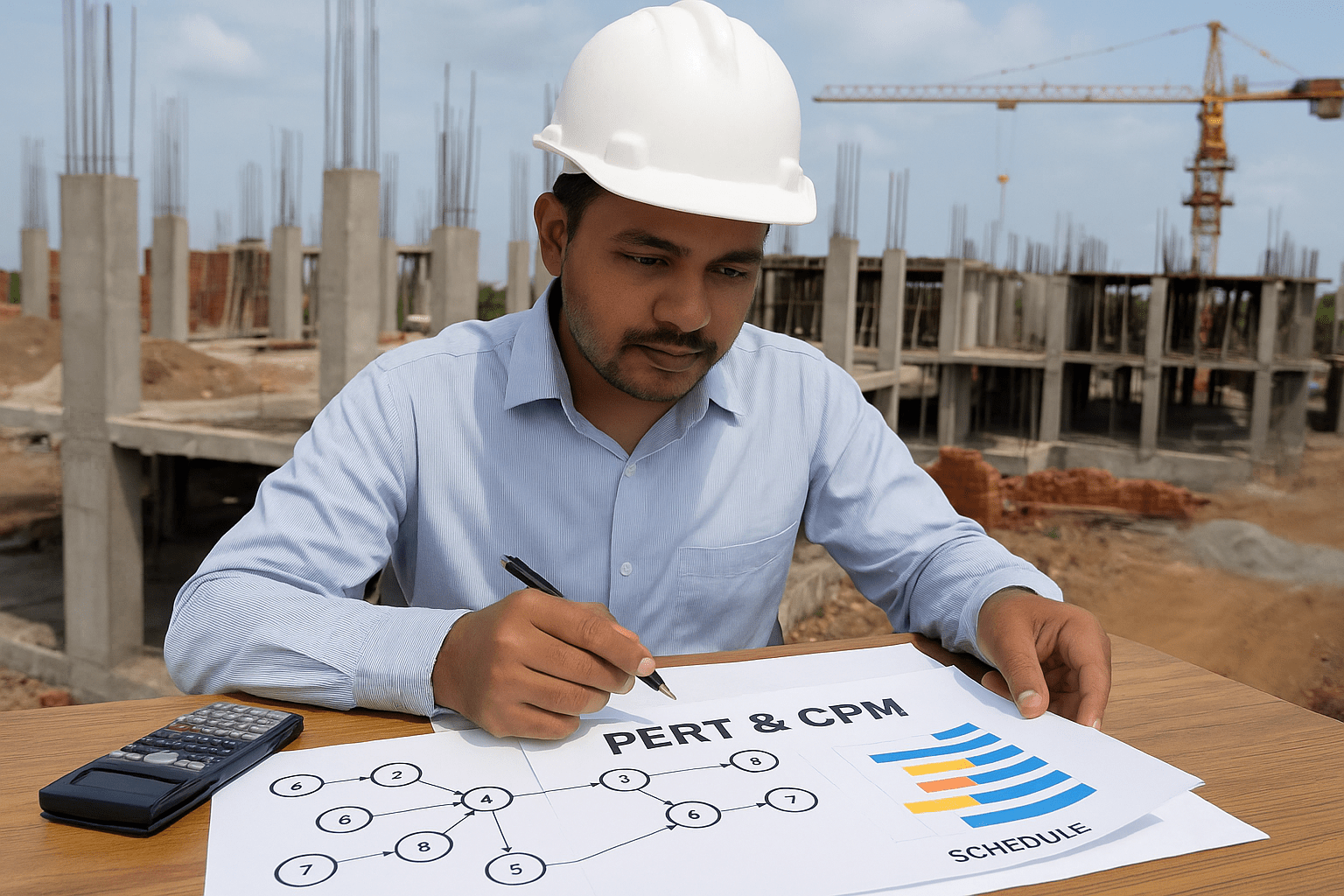
In India’s rapidly transforming built environment, ranging from urban infrastructure to high-density residential townships, the ability to execute projects on time and within budget is not a mere operational necessity but a strategic differentiator. This is where advanced project scheduling methodologies like PERT (Program Evaluation and Review Technique) and CPM (Critical Path Method) play a pivotal role.
While both techniques originated in the mid-20th century to address large-scale industrial and defense-related scheduling challenges, their relevance has only grown in India’s increasingly complex real estate and infrastructure ecosystem.
PERT vs. CPM: A Conceptual Overview
PERT is a probabilistic time management tool ideal for projects with uncertain activity durations. It uses three time estimates, optimistic, pessimistic, and most likely, to derive an expected timeline through statistical analysis.
CPM, in contrast, is deterministic and better suited for projects with clearly defined tasks and timelines. It identifies the critical path, the longest chain of dependent activities that directly determines the minimum project duration.
In essence, PERT is a tool for planning uncertainty; CPM is a tool for managing certainty.
Application in the Indian Construction Ecosystem
1. Robust Scheduling Under Ambiguity
Indian construction projects, particularly public sector and PPP initiatives, often face schedule volatility due to delays in land acquisition, erratic monsoons, labor availability, or shifts in policy frameworks. In such environments:
- PERT enables project managers to build contingencies through buffer periods based on probabilistic analysis.
- CPM highlights critical activities, ensuring that focus remains on the most time-sensitive elements of execution.
- This dual approach allows project teams to optimize the project baseline while retaining flexibility for real-world disruptions.
2. Strategic Resource Allocation
Given the fragmented nature of resource mobilization in India’s tier-2 and tier-3 cities:
CPM facilitates efficient labor, material, and equipment scheduling, minimizing idle time and resource redundancy.
The method’s capacity for activity crashing (accelerating task completion by allocating additional resources) is particularly beneficial in fast-tracked infrastructure and affordable housing projects funded by time-bound subsidies or fiscal incentives.
3. Cost-Time Optimization
Time overruns remain a chronic issue in Indian real estate, often leading to cascading cost escalations. Here, CPM’s cost-time trade-off capability becomes invaluable:
- Developers can assess the financial viability of accelerating certain phases (e.g., structural completion) without compromising quality.
- PERT aids in risk-adjusted cost modeling by introducing probabilities into delay assessments, improving financial forecasting accuracy.
4. Enhanced Stakeholder Communication
Both PERT and CPM utilize network diagrams and Gantt charts, which are intuitive visual tools for:
- Aligning expectations across internal teams, external contractors, and regulatory agencies.
- Facilitating transparent project status reviews with financiers and government monitoring bodies under RERA or Smart City missions.
Implementation Challenges in India
Despite their benefits, real-world adoption in India, particularly by small and mid-sized contractors, is limited due to:
- Low penetration of project management software in regional firms.
- A skill gap in using data-driven planning tools among site engineers and supervisors.
- Regulatory unpredictability, which undermines even the most meticulous planning, especially in peri-urban zones.
Nevertheless, the increasing digitalization of real estate (e.g., BIM, ERP systems) and the government’s emphasis on infrastructure modernization are accelerating the professionalization of project planning frameworks.
Looking Ahead: A Strategic Imperative
For Indian real estate developers and EPC contractors aiming for operational excellence, PERT and CPM are no longer optional academic tools, they are strategic enablers. As timelines tighten and investor expectations grow sharper, integrating these methodologies within the broader project governance architecture is crucial.
Moreover, with the rise of sustainability-linked financing and ESG compliance, timely delivery is becoming a key non-financial metric. PERT and CPM, by making delays predictable and avoidable, serve both economic and reputational imperatives.
In the evolving landscape of Indian construction, PERT and CPM offer a rigorously structured yet adaptable framework for navigating uncertainty, optimizing workflows, and institutionalizing accountability. Their true value lies not merely in theoretical precision but in empowering decision-makers to turn complexity into clarity, and deadlines into deliverables.