
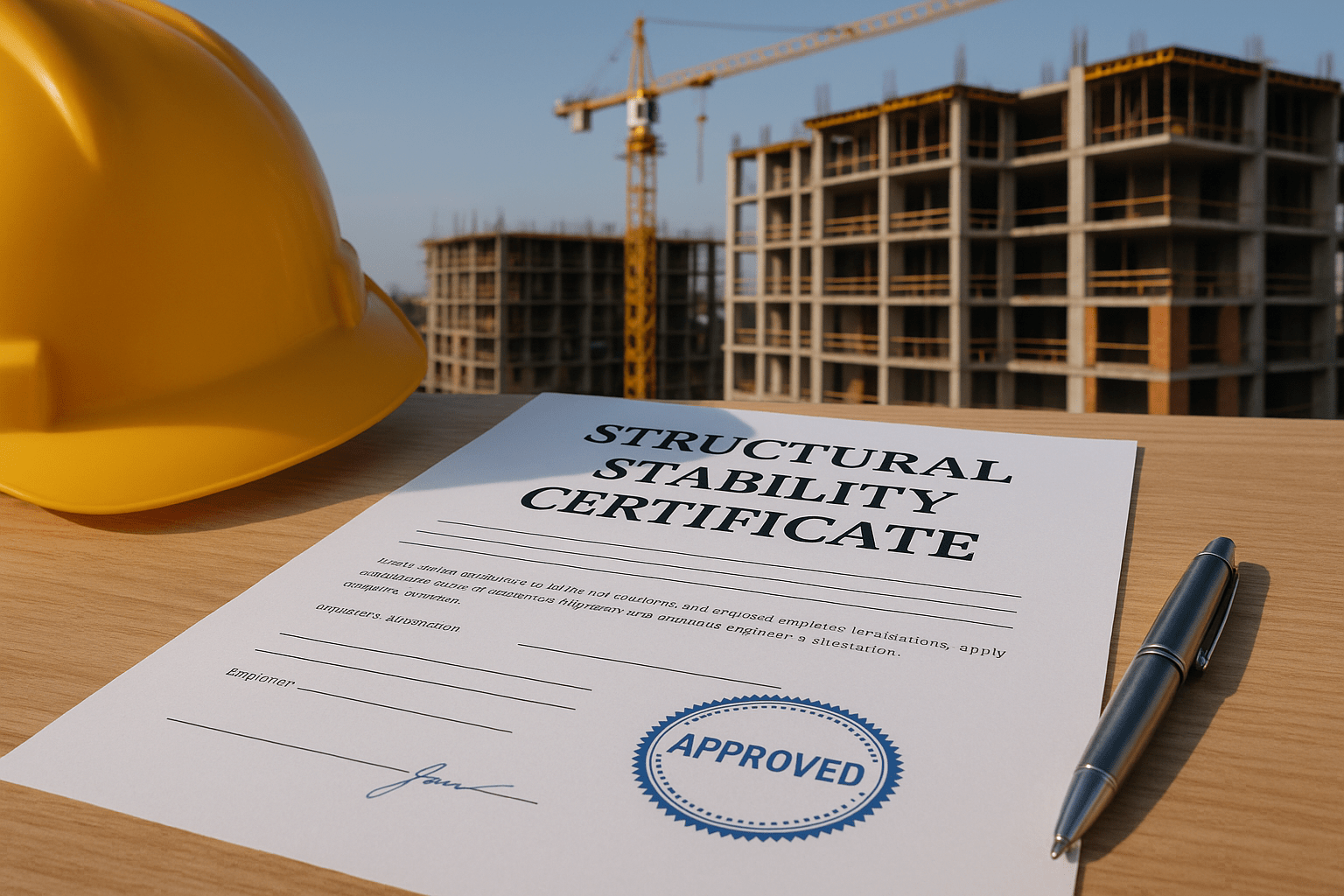
In India’s densely built urban corridors and rapidly expanding peri-urban landscapes, the emphasis on real estate development is often skewed toward aesthetics, amenities, and timelines. Yet, behind the façade of a completed project lies an often-underappreciated but critically important document: the Structural Stability Certificate. This certificate, typically mandated by urban local bodies, is not a mere procedural formality, it is a legal and technical affirmation of the structural soundness of a building.
For stakeholders ranging from developers and architects to homeowners and policy regulators, understanding the implications of this certificate is essential not only for legal compliance but also for long-term safety, risk mitigation, and asset preservation.
What Is a Structural Stability Certificate?
A Structural Stability Certificate is an official document issued by a licensed structural engineer or certified consultancy, confirming that a building’s load-bearing elements, columns, beams, foundations, and slabs are sound, free from critical defects, and capable of withstanding environmental and functional stresses within prescribed limits.
This certificate is rooted in empirical evaluation and compliance with Indian Standards (IS) codes such as IS 456 (RCC structures), IS 875 (structural loads), and, where applicable, IS 1893 (seismic design). It goes beyond visual inspection to incorporate engineering calculations, material assessment, and, often, non-destructive testing methods.
When Is It Required?
1) Post-Construction / Occupancy Certificate (OC)
Local municipal authorities typically require a structural stability certificate before issuing the OC. Without it, legally occupying the building may be impermissible.
2) Redevelopment or Demolition Assessment
In aging urban zones such as Mumbai or Kolkata, where buildings often exceed 30–50 years in service life, the certificate is crucial for assessing whether the structure is viable for continued use or requires demolition.
3) Major Structural Alterations
For vertical expansions, change of use (e.g., converting residential to commercial), or retrofitting, the certificate confirms that the proposed modifications will not compromise the integrity of the original structure.
4) Periodic Certification for Public and Industrial Buildings
Certain classes of buildings, industrial plants, schools, hospitals, and high-rise apartments are mandated to undergo periodic structural audits and recertification.
What Does the Evaluation Cover?
A structural engineer issuing this certificate must assess:
- Load-Bearing Integrity: Verification of structural load paths from the superstructure to the substructure.
- Material Degradation: Cracks, corrosion, deflection, or carbonation of concrete are key red flags.
- Foundation Settlement: Geotechnical impact over time, especially relevant in flood-prone or reclaimed land zones.
- Design and Execution Consistency: Cross-verification of the built structure against the sanctioned design and structural drawings.
- Environmental Suitability: Compliance with seismic zoning norms (especially in Zones III–V) and wind load resistance.
Legal and Regulatory Implications
1. National Building Code (NBC) and IS Code Compliance
The NBC prescribes structural safety as a minimum performance standard. A structural stability certificate ensures that this obligation has been independently validated.
2. RERA Alignment
Under Section 11 of the Real Estate (Regulation and Development) Act, 2016, the promoter is responsible for the structural safety of the project for five years post-handover. A structural certificate can be a critical part of the project’s compliance dossier.
3. Municipal Bye-Laws
Cities like Bengaluru, Chennai, and Delhi mandate structural certification for buildings beyond a certain age (typically 30 years), especially before issuing no-objection certificates for redevelopment or repair.
In the Indian construction milieu, where regulatory enforcement varies and cost-cutting can compromise quality, the Structural Stability Certificate emerges as both a technical safeguard and an ethical commitment. For developers, it substantiates structural accountability; for financiers, it signals reduced project risk; and for residents, it is an assurance of safety in their most valuable asset.
Given the rising frequency of structural failures, from minor facade collapses to catastrophic cave-ins, integrating structural stability assessments at multiple lifecycle stages, design, post-construction, and periodic intervals, is no longer optional. It is imperative.