
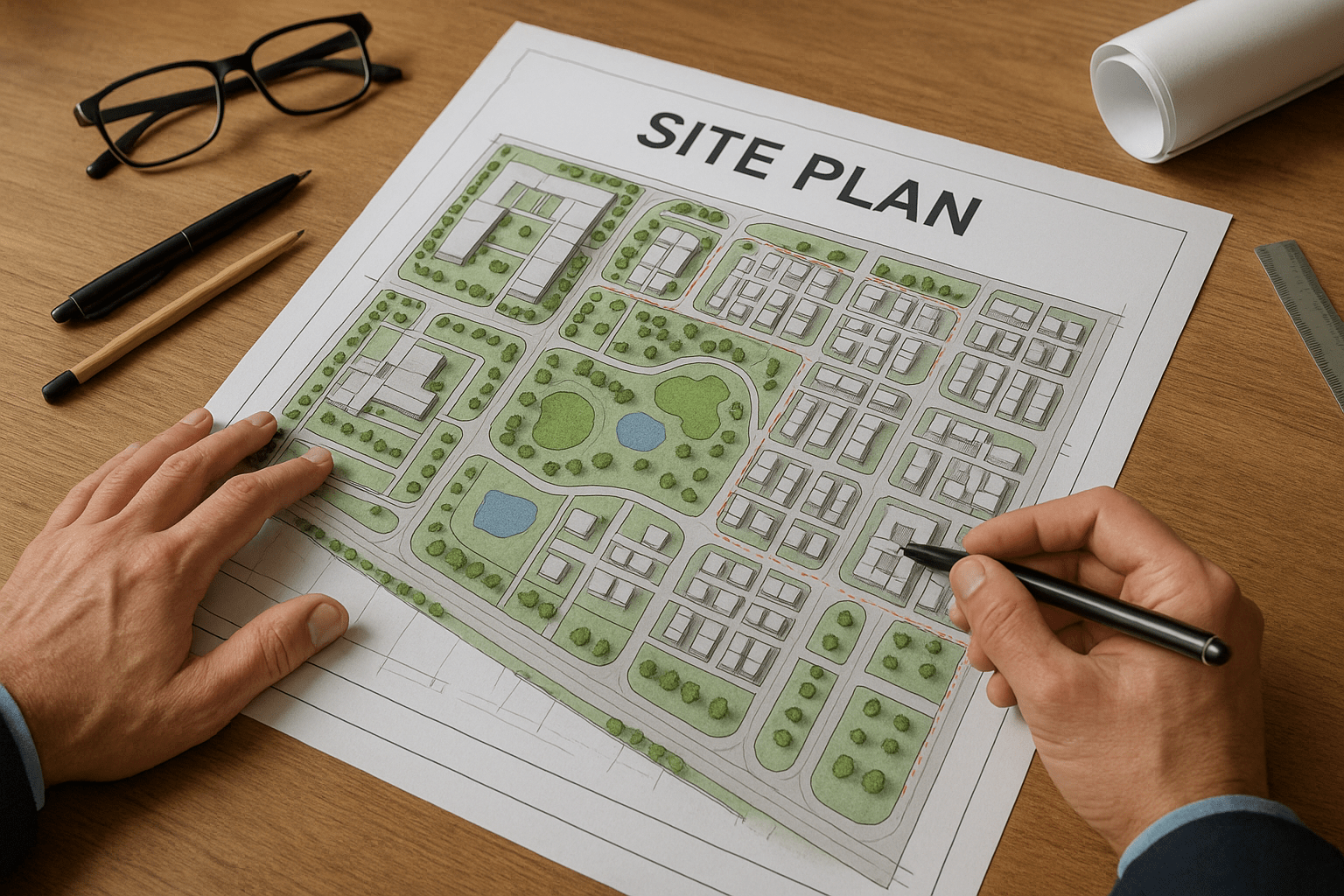
In the architecture of real estate development, a meticulously crafted site plan is more than just a regulatory prerequisite, it is a cartographic expression of intent, vision, and technical feasibility. Whether for high-rise residential towers, institutional complexes, or integrated townships, the site plan articulates the spatial logic of the built environment, integrating regulatory compliance, environmental stewardship, and functional design.
In India’s evolving urban fabric, where land utilization is intensively scrutinized and municipal norms vary across jurisdictions, the site plan assumes particular significance. It not only facilitates permissions but also ensures that the built structure harmonizes with its surroundings and infrastructure ecosystem.
What is a Site Plan?
A site plan, often referred to as a plot plan, is a scale-drawn architectural document that captures both existing site conditions and proposed interventions on a given parcel of land. Its purpose is dual: technical, guiding engineers and contractors, and legal, ensuring conformity with land use, zoning, and building codes under municipal regulations like the Unified Building By-laws or Development Control Rules.
Essential Components of a Site Plan
Each element of the site plan serves a specific regulatory or spatial function:
1. Property Boundaries and Plot Extents
At its core, the site plan begins with the precise delineation of legal boundaries, as verified through revenue records, mutation entries, or property title deeds. Accurate demarcation ensures that development remains within lawful limits, avoids encroachment, and serves as a critical reference during litigation or land acquisition proceedings.
2. Building Footprint and Orientation
The footprint defines the spatial imprint of the proposed structure, encompassing its dimensions, shape, and orientation. This component considers solar geometry (for passive design), wind patterns, and urban setbacks, ensuring environmental responsiveness and compliance with Floor Area Ratio (FAR) or Floor Space Index (FSI) norms.
3. Setbacks and Margins
Setback regulations, prescribed under municipal bylaws, govern the minimum spatial buffers between the building and the site’s edges. These zones ensure ventilation, privacy, fire safety access, and in some cities, provisions for future infrastructure expansion. Misinterpretation or under-provisioning of setbacks often becomes a leading cause of plan rejection.
4. Circulation and Parking
Vehicular movement patterns, entry/exit points, and internal roads are plotted alongside designated parking bays for two-wheelers and four-wheelers. The plan must adhere to parking ratios based on usage type (residential, commercial, institutional) as specified in local building codes.
5. Open Areas and Landscape Integration
Green cover, through tree plantations, permeable surfaces, and landscaped courts, enhances the site’s ecological performance. Increasingly, these features are aligned with sustainability certifications (e.g., IGBC, GRIHA) and stormwater management protocols. Softscape-hardscape balance also plays a role in microclimate regulation.
6. Utility and Infrastructure Networks
The blueprint should explicitly map the connectivity of the site with civic infrastructure:
- Water supply networks (including underground reservoirs and overhead tanks)
- Sewage and stormwater drains (with alignment to municipal mains)
- Electric substations, cabling, and metering rooms
- Firefighting systems, including hydrant locations and refuge areas, comply with NBC 2016
7. Topography and Contours
In hilly terrains or flood-prone zones, topographical mapping becomes essential. Contour lines inform slope stability, basement feasibility, and site grading strategies.
Why a Site Plan is Indispensable
1) Regulatory Compliance: It is a prerequisite for obtaining key statutory approvals, including Building Plan Sanction, Commencement Certificate, and Occupancy Certificate.
2) Design Coordination: It acts as the primary coordination tool across disciplines, architecture, structural engineering, MEP, and landscape.
3) Risk Management: By highlighting spatial constraints and conflicts early on, it prevents costly mid-course corrections during execution.
4) Transparency and Due Diligence: It facilitates clarity for financial institutions, RERA authorities, and end-buyers regarding project viability and scope.
A site plan, when treated not as a perfunctory submission but as a living instrument of design intent, becomes the architectural DNA of a project. It reflects the confluence of aesthetics, policy, engineering, and ecology. For developers, investors, and professionals navigating India’s urban development milieu, a rigorously detailed site plan is a strategic imperative, not just a statutory checkbox.