
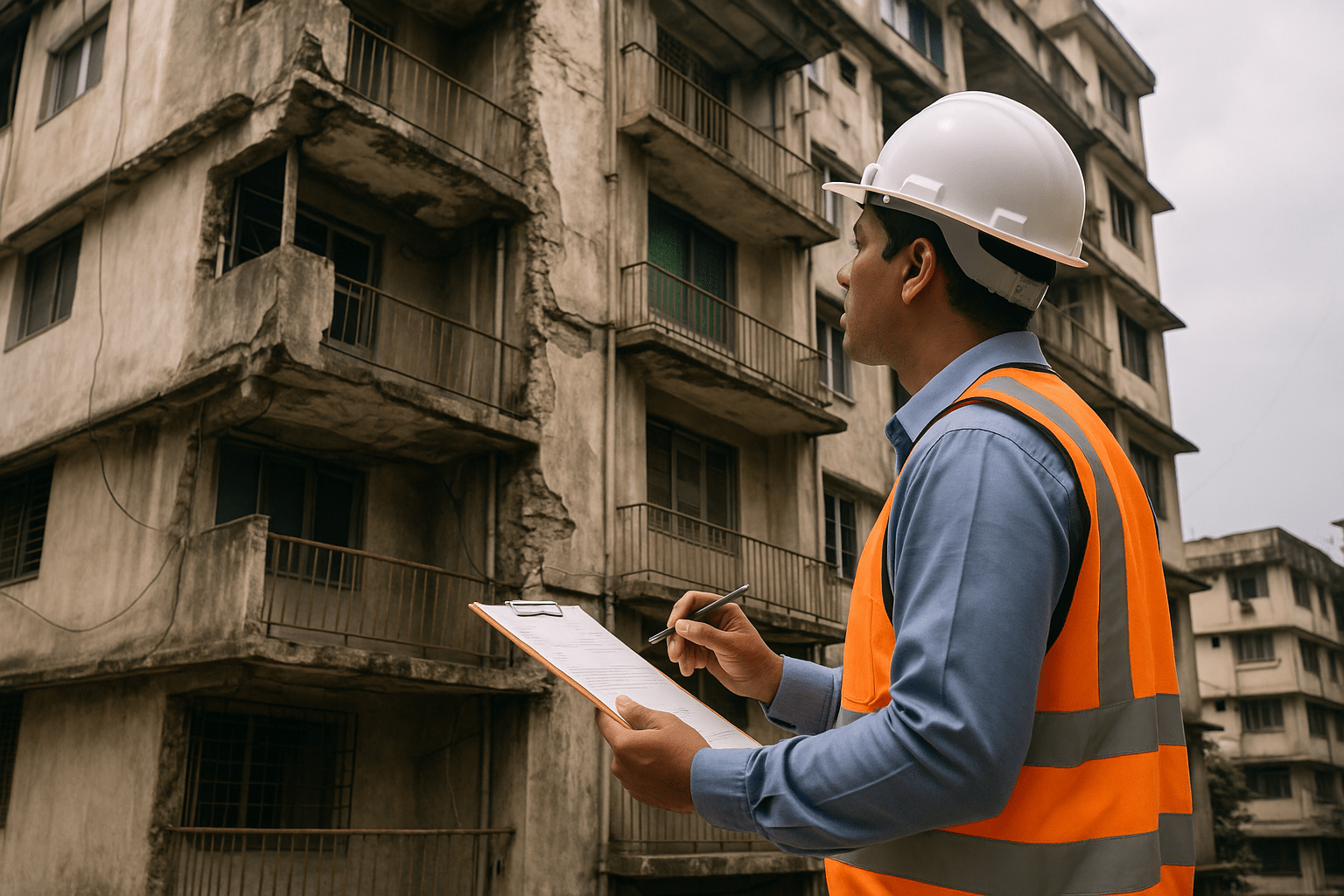
As India’s cities grow upward and outward, a crucial question often goes unnoticed: Are our buildings structurally safe? In the race to modernise, many ageing buildings in urban centres, particularly in Mumbai, Pune, Delhi, and Bengaluru, now face the pressures of time, climate, and continuous use. That’s where structural audits come in.
A structural audit is not just a box to tick on a regulatory form, it is a proactive tool to prevent disaster, safeguard lives, and plan for the future.
What is a Structural Audit?
A structural audit is a professional inspection of a building’s strength and stability. It examines the condition of key load-bearing components, columns, beams, slabs, foundations, and retaining walls, to assess whether a building is safe to occupy.
These audits are conducted by licensed structural engineers using a combination of:
- Visual assessments
- Non-destructive testing (NDT) techniques
- Reviews of original design and structural drawings
The goal is simple: detect problems early and recommend timely corrective action.
Why Structural Audits Are Essential Today
1. Public Safety First
What may look like a minor crack or water stain could be a symptom of deeper structural damage. Audits help identify such hidden risks long before they pose serious threats.
2. Cost-Effective in the Long Run
Fixing a small issue today is far more affordable than dealing with a major structural failure tomorrow. Proactive maintenance based on audit findings can save lakhs in emergency repairs or legal disputes.
3. Legal Compliance
Cities like Mumbai and Pune require structural audits at regular intervals, typically every 5 years for buildings older than 15 or 30 years, depending on local laws. Non-compliance can result in penalties, disconnection of civic services, or even criminal liability for housing society members if negligence leads to harm.
4. Redevelopment Planning
An audit provides a neutral, technical assessment of whether a building should undergo minor repairs, structural strengthening, or complete redevelopment. This is especially important when multiple stakeholders, owners, societies, or developers are involved.
5. Climate Resilience
With changing weather patterns, increased rainfall, flooding, and seismic activity, building resilience is no longer optional. Structural audits help cities prepare by ensuring existing stock is capable of withstanding new environmental pressures.
Legal Framework: City-Specific Mandates
- Mumbai (BMC): Mandatory every 5 years for buildings older than 30 years (earlier for cessed buildings)
- Pune (PMC): Required every 5 years after 15 years of age
- Delhi, Bengaluru, and others: No citywide mandate yet, but courts are increasingly holding owners accountable for audit lapses
In cases of collapse or structural failure, office bearers and owners may face civil and even criminal liability if an audit was skipped or ignored.
How a Structural Audit is Conducted
A. Preliminary Visual Inspection
- Cracks, water seepage, rust, deflection, and settlement signs
- Observation of column alignment, beam deflection, or unusual tilting
B. Document Review
- Evaluation of original design plans, past modifications, and maintenance history
- Checking for changes in building use or added loads (e.g., extra water tanks, rooftop equipment)
C. Non-Destructive Testing (NDT)
Depending on the findings, engineers may perform tests such as:
- Rebound Hammer Test – for surface hardness and compressive strength of concrete
- Ultrasonic Pulse Velocity Test – to detect internal cracks or voids
- Half-Cell Potential Test – to assess steel corrosion in RCC structures
- Carbonation Depth Test or Core Cutting – in critical areas, if needed
D. Reporting & Recommendations
The final report includes:
- A structural health grade (safe, repairable, or unfit)
- A priority list of recommended repairs or retrofitting
- An estimate of the costs involved
- Suggestions for redevelopment, if needed
When Should a Structural Audit Be Done?
- Every 5 years after a building crosses 15–30 years of age
- After a natural disaster like flooding or an earthquake
- Before major renovations or additions (like an extra floor or lift)
- When visible damage or unusual movement is observed
- As a prerequisite for redevelopment proposals
In Indian cities, where many buildings date back several decades and continue to house thousands, structural audits should not be treated as a formality. They are essential for safety, compliance, and informed decision-making.
For housing societies, it’s about protecting residents and reducing liability. For developers, it offers clarity on redevelopment viability. And for urban planners, it is a step toward building more resilient cities.
Because at the heart of every safe city is a safe structure, and that safety begins with a structural audit.