
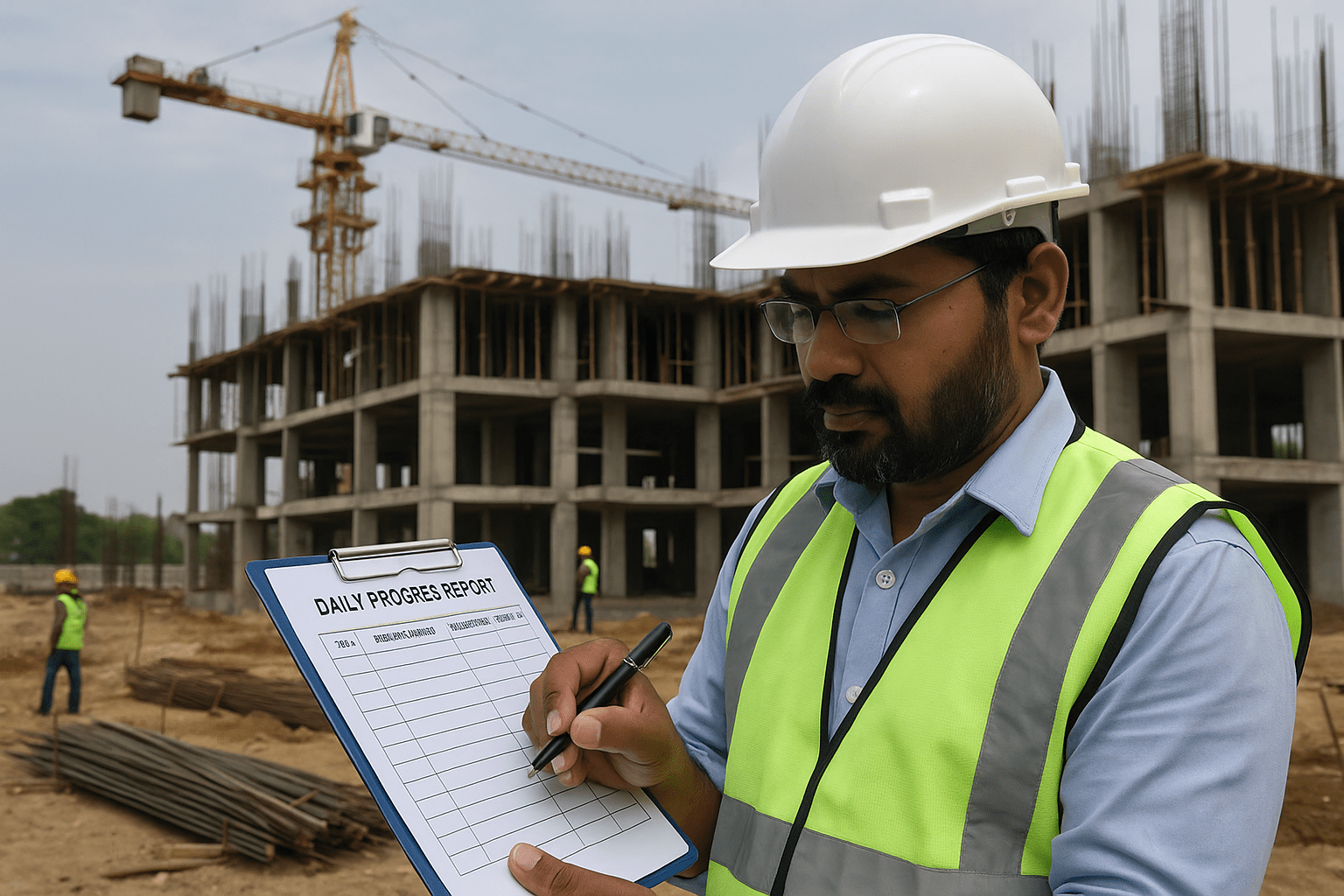
In India’s complex and capital-intensive real estate and infrastructure landscape, where projects must balance regulatory compliance, cost control, and time-bound execution, robust site management systems are essential. Among the most underappreciated yet pivotal tools in this matrix is the Daily Progress Report (DPR). Far from being a mere checklist or clerical exercise, the DPR functions as a critical instrument for operational intelligence, governance, and strategic alignment.
This article explores the centrality of DPRs in Indian site management, unpacking their structure, utility, and strategic implications for developers, project managers, regulatory bodies, and investors.
What is a DPR?
A Daily Progress Report is a systematic log that captures the day-to-day operational activities on a construction site. It documents resource deployment, physical progress, work completed, site conditions, and deviations from schedule or plan.
Traditionally used in public infrastructure projects (e.g., by CPWD, NHAI, and state PWDs), DPRs have now become standard across private real estate developments, especially those governed under the Real Estate (Regulation and Development) Act, 2016 (RERA). Increasingly, these reports are digitized and integrated into ERP and project management platforms for real-time visibility.
Why DPRs Matter: A Multi-Dimensional View
1. Real-Time Project Governance
In Indian construction projects, often fragmented across subcontractors, multiple agencies, and volatile supply chains, DPRs serve as the foundation for micro-level project control. They facilitate:
- Daily benchmarking of actual vs. planned outputs
- Rapid identification of delays, labor shortfalls, or design discrepancies
- Preventive action before small issues metastasize into cost overruns
This real-time loop is especially critical in EPC, affordable housing, and infrastructure projects where delays have cascading contractual and financial implications.
2. Operational Accountability Across the Value Chain
A well-structured DPR captures granular data on:
- Labor attendance and productivity
- Plant and machinery utilization
- Material inward/outward movement
- Health, safety, and environment (HSE) compliance
This level of transparency enforces bottom-up accountability, holding vendors, engineers, and subcontractors accountable for daily deliverables. Over time, it enables pattern recognition, such as recurrent bottlenecks or underperforming crews, leading to improved procurement and HR decisions.
3. Enhanced Inter-Stakeholder Communication
DPRs bridge the communication gap between site-level execution teams and corporate or client-side decision-makers. They offer a data-driven basis for escalating issues such as:
- Permit or approval delays
- Material stockouts or quality deviations
- Safety violations or near misses
For RERA-compliant projects, DPRs also provide source data for mandatory quarterly updates to allottees and authorities, enhancing transparency and buyer confidence.
4. Contractual and Legal Safeguards
Construction projects in India are prone to claims, delays, and disputes, whether due to force majeure events, contractor non-performance, or regulatory hold-ups. Here, DPRs assume a quasi-legal status as contemporaneous documentation of:
- Progress achieved and tasks pending
- Contractor compliance with the scope and timelines
- External impediments beyond developer control
This documentation becomes invaluable in arbitration or claims for extension of time (EOT), liquidated damages, or cost escalation.
5. Resource and Cost Optimization
The granular insights captured in DPRs feed into analytics dashboards that can track trends in:
- Labor productivity by trade or subcontractor
- Equipment idle time vs. operating efficiency
- Daily consumption rates of key materials (steel, cement, aggregates)
These insights enable data-driven resource allocation, critical in capital-constrained environments or high-volume phased developments.
Toward Strategic Institutionalization
Despite their importance, DPRs are often underutilized due to manual reporting, lack of standardization, or absence of integration with higher-level project controls. Leading developers are now addressing this gap by:
- Embedding DPR modules within Construction Management Software (CMS)
- Training site engineers in documentation best practices
- Linking DPR data to earned value management (EVM) and performance KPIs
In the increasingly formalized, investor-driven Indian real estate and infrastructure ecosystem, DPRs are not clerical rituals, they are strategic instruments. They consolidate operational data, enhance institutional memory, and create an audit trail that underpins decision-making, governance, and value creation.
For forward-looking developers, embracing DPRs as a strategic asset, rather than a compliance burden, is key to achieving execution excellence, stakeholder trust, and sustainable growth.